
A Small Visit, A Big Step
A pediatric visit is not only about completing treatment. It is about helping a child feel safe enough to take the next step.
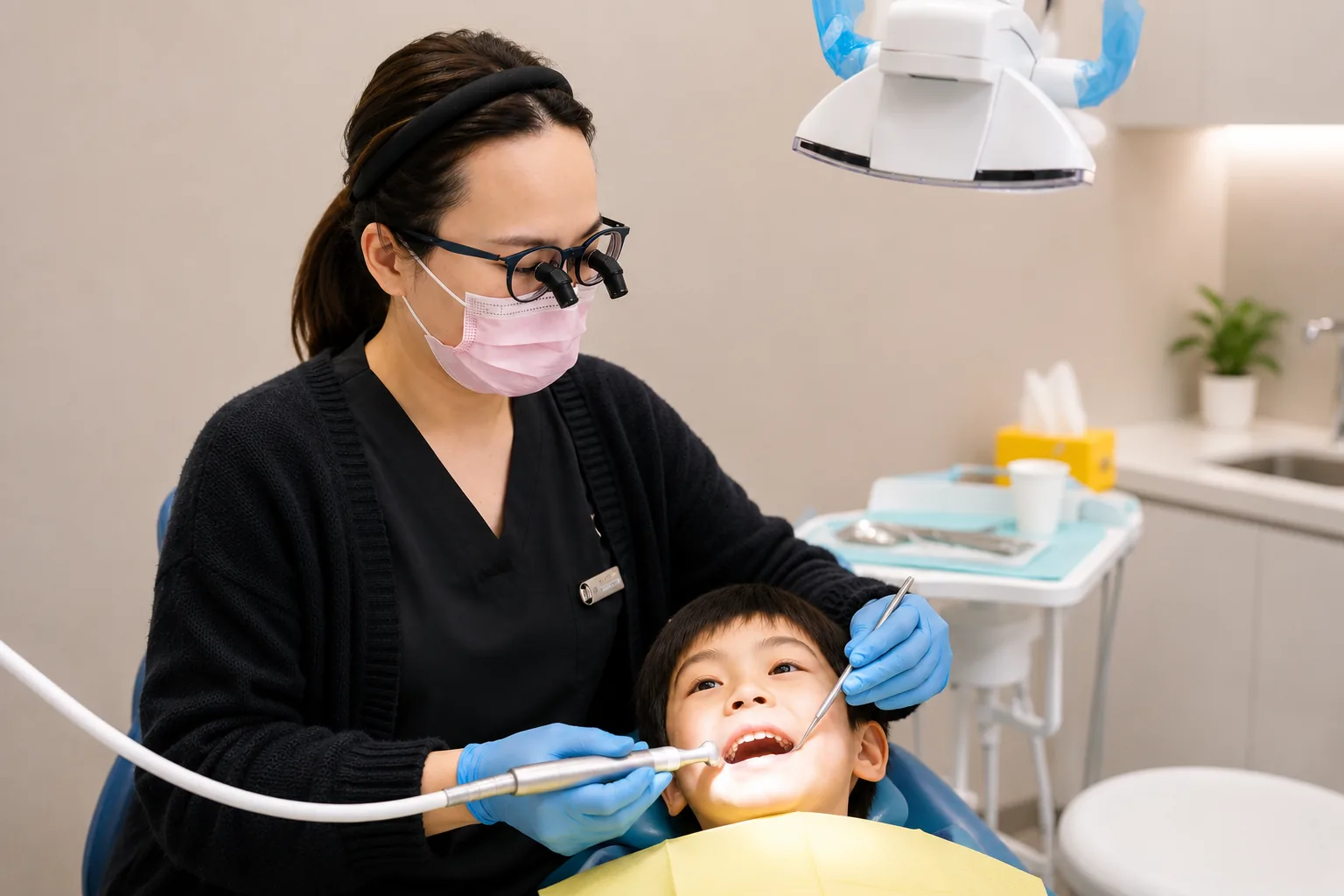
He walked into the room holding a small toy.
He was not loud.
He was not crying.
But his whole body was tense.
His eyes kept moving around the room: the light, the chair, the instruments, the hands of the dentist.
For a child, everything in a dental clinic can feel unfamiliar.
The light turns on.
The chair moves.
The equipment makes sounds.
Adults say words that are hard to understand.
So we did not begin by asking him to open his mouth.
We first let him sit on the dental chair.
We showed him how the chair would move slowly.
We shone the light on his hand first, so he could understand that the light was only bright, not painful.
We let him see and touch the mirror before placing it in his mouth.
Before treatment began, a lot had already happened.
Not on the teeth.
But in his sense of safety.
His mother sat beside him, looking even more nervous than he was.
One of his front teeth had changed color, and there were signs of recurring inflammation near the gum.
For a parent, this is never just a small dental issue.
They worry:
Will it hurt?
Will the tooth need to be removed?
Will this experience make him afraid of dentists in the future?
These worries cannot be answered by simply saying, “It’s fine.”
So we slowed everything down.
As we examined him, we explained each step before it happened.
Not because a child needs to understand every clinical decision, but because he needs to know what is coming next.
“Now we are only taking a look.”
“This part may have a little water.”
“If you need to stop, you can raise your hand.”
At first, he opened his mouth only a little.
Whenever he felt uncomfortable, his eyebrows tightened and his hand lifted slightly.
So we paused.
Not because we could not continue, but because in pediatric dentistry, pausing is part of the treatment.
If a child feels that he has no control, he may not trust the dental chair next time.
But if he learns that he can pause, reset, and be heard, the visit becomes more than a procedure.
It becomes the beginning of cooperation.
Slowly, he opened his mouth for longer.
From a few seconds to more than ten.
From needing reminders to cooperating on his own.
From looking constantly at his mother to watching the small mirror in the dentist’s hand.
He did not suddenly become “brave.”
He simply managed to stay with the process a little longer each time.
And that matters.
In pediatric dentistry, the most valuable outcome is not always how much treatment is completed in one visit.
It is whether the child leaves with a memory that makes the next visit easier.
If the first memory is fear, every visit after that becomes harder.
If the first memory is, “I can do this,” then every next step becomes a little easier.
At the end, he sat up with the quiet expression of someone who had tried very hard.
We asked him, “Were you brave today?”
He did not answer immediately.
He looked at his mother, then at us, and finally reached out his hand for a soft high-five.
It was a very small gesture.
But for us, it was the most important result of the day.
What he learned first was not how to open his mouth.
He learned that he could take his time.