
Knowledge Center · PEDIATRIC DENTISTRY
Early Orthodontic Intervention During Mixed Dentition
Early intervention is neither passive waiting nor starting treatment as early as possible. It uses digital records, space management, pediatric clear aligners, and habit guidance to build a better foundation for the child’s bite and future care.
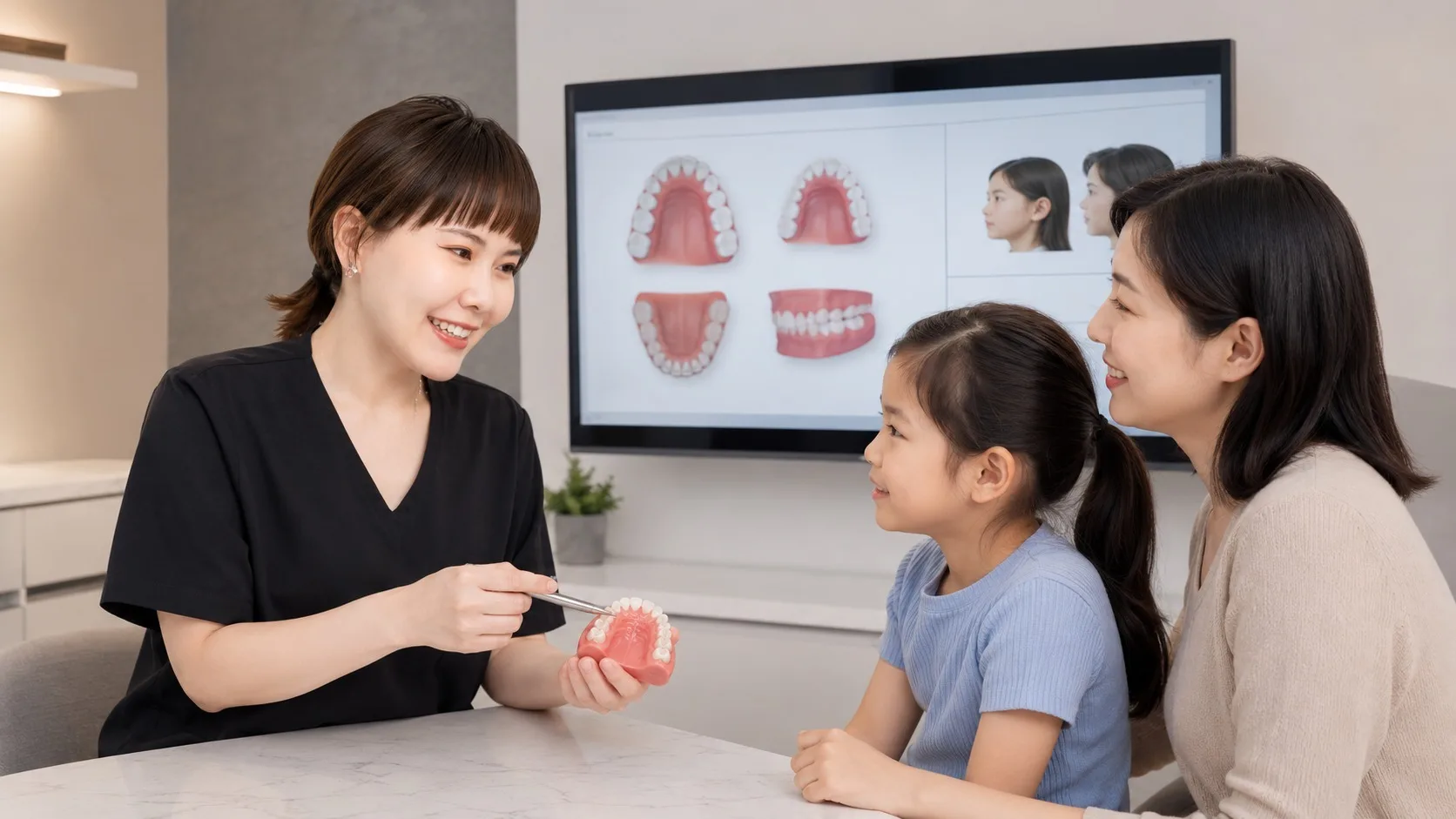
The years when a child is changing teeth are one of the most active periods of dental and bite development.
Baby teeth gradually loosen, permanent teeth begin to erupt, the dental arch develops, upper and lower jaw relationships form, and the child’s hygiene habits, breathing habits, and cooperation with dental care all begin to take shape.
This stage is not just about “waiting until all teeth have changed.”
It is an important management stage in a child’s oral development.
The meaning of early orthodontic intervention is to use examination, digital records, and phased planning to help the dentist and parents understand how the teeth are erupting, whether there is enough space, how the bite is developing, and when the next step should be considered.
Some children are best managed with regular observation.
Some benefit from habit management.
Some are suitable for pediatric clear aligners, space management, or phased orthodontic treatment to guide the arch, tooth alignment, and bite relationship in a better direction.
The point is not “the earlier, the better.”
It is using the right method at the right stage to build a better foundation for the child’s teeth and bite.
The mixed dentition stage is a key period in development
Teeth change quickly during the mixed dentition stage.
After the front teeth erupt, arch space becomes more visible. As lateral incisors, canines, and posterior teeth come in, alignment and bite relationships continue to change.
At this stage, the dentist is not only looking at whether one tooth is straight right now. The focus is the developmental direction of the entire arch and bite.
For example:
- whether there is enough space for permanent teeth;
- whether arch width is coordinated;
- whether front and back tooth bite relationships are stable;
- whether upper and lower jaw relationships are harmonious;
- whether oral habits are influencing arch form;
- whether the child’s hygiene and cooperation can support treatment.
These observations help parents better understand the child’s growth rhythm.
The value of early intervention is to record these changes early so that later decisions have a clearer direction.
Early intervention can mean space management or phased treatment
Early intervention is not a single fixed treatment. It is a management approach designed according to the child’s stage of tooth replacement.
Some children need regular observation and review. Some need habit guidance. Some are suitable for phased treatment that guides the teeth and arch toward a better direction.
Space management is an important part of this.
As permanent teeth erupt, the dentist can evaluate tooth size, arch space, the sequence of baby tooth loss, and eruption direction, then decide whether early management can help space be used more effectively.
For suitable children, pediatric clear aligners can also be part of early intervention.
They are not only used to “make teeth straight.” They can also help with:
- managing eruption space;
- guiding front tooth alignment;
- improving mild to moderate crowding;
- adjusting arch form;
- helping establish a better bite relationship;
- and making each stage’s goal clearer for the child and parents.
The advantage is that the stage goals can be understood more clearly. Parents and children can see which teeth are being guided, why the movement is being planned, and what should be observed next.
Pediatric clear aligners can make early management easier to understand
Early orthodontic treatment for children used to feel complex: appliances were hard for children to understand, and parents were not always clear about what each step was doing.
Digital clear aligner planning makes the process more visual.
The dentist can use intraoral scanning to create a 3D record of the child’s teeth, then design a phased plan based on the mixed dentition stage and treatment goals. Parents can see the general direction of tooth movement, and the child can better understand why aligners are worn, why follow-up visits matter, and why hygiene is important.
This matters in pediatric care.
Children are not passive recipients of treatment.
When they can see and understand their own tooth changes, they are more likely to participate.
The value of pediatric clear aligners is not only appearance or removability. More importantly, they make early space management, staged tooth movement, and family cooperation clearer.
Digital records make growth changes comparable
A child’s oral development is continuous.
If every visit is judged only by impression, it is difficult to truly understand how the teeth and arch are changing. Intraoral scans, photographs, and necessary imaging records can save the child’s oral condition at different stages.
These records can be used to compare:
- arch space now versus six months ago;
- changes in permanent tooth eruption direction;
- whether the front tooth alignment is becoming more coordinated;
- whether clear aligner stage goals are being achieved;
- whether habit changes are influencing teeth and bite;
- and whether the child is ready for the next stage of treatment.
The value of digital records is not to make treatment look more complicated. It is to make the child’s growth visible, comparable, and explainable.
Parents are not only told “there has been a change.” They can understand where the change happened through records.
Teeth, bite, and habits should be managed together
Early intervention should not look only at tooth alignment.
Arch width, jaw relationship, tongue posture, lip strength, breathing pattern, chewing habits, and hygiene ability can all influence final alignment and bite stability.
That is why early evaluation at D4 considers:
- tooth alignment;
- arch space;
- bite relationship;
- facial development;
- mouth breathing, thumb sucking, tongue thrusting, lip biting, and other habits;
- the child’s cooperation and hygiene ability;
- and whether parents understand the management rhythm.
Only by seeing these together can the dentist decide whether the child is best suited for observation, habit management, pediatric clear aligners, or another phased intervention.
This is not simply about whether the teeth are straight. It is about managing the child’s entire oral development system.
Early intervention also builds confidence with dental care
Pediatric treatment is not only technical. It also includes how the child feels.
A child who is willing to open their mouth, communicate, cooperate with photographs, scanning, cleaning, and reviews already has an important foundation.
With gentle explanation, visual records, and stage-based goals, children can understand that the dentist is not suddenly asking them to do something unfamiliar. The dentist is helping them learn about their own teeth and move through a growth process together.
This is also part of early intervention.
When children develop a clear, stable, and understandable dental experience early, future prevention, treatment, orthodontics, and long-term maintenance all become smoother.
How D4 approaches early intervention
At D4, early intervention is not simply starting treatment earlier. It is about actively building records during the mixed dentition stage, understanding the child’s developmental stage, and choosing the right management tool.
We look at the child’s age, tooth replacement stage, alignment, arch space, bite relationship, facial development, oral habits, and cooperation.
Then we decide:
regular observation or habit management;
space management or phased treatment;
pediatric clear aligners or another suitable method;
treatment now, or building clearer records for the next orthodontic stage.
The value of early intervention is helping parents understand the child’s growth, helping the child trust dental care, and making the teeth, arches, bite, and future treatment path clearer.
For the child, this is not a single isolated treatment.
It is a better starting point for the future smile, bite, and oral health.
FAQ
At what age should a child have the first tooth and bite evaluation?
Many children can have an alignment and bite evaluation around age 6 to 8, during the early mixed dentition stage. This allows the dentist to observe permanent tooth eruption, arch space, jaw relationships, and oral habits. The goal is not to decide immediately whether treatment is needed, but to understand the child’s current stage and build a direction for observation, space management, or phased intervention.
Can early intervention be done with clear aligners for children?
Yes. For suitable children, pediatric clear aligners can be used for phased space management, front tooth alignment guidance, mild to moderate crowding improvement, arch form adjustment, and bite development. The advantage is that treatment goals are easier to understand through a digital plan. Suitability depends on the mixed dentition stage, scan records, bite relationship, and the child’s cooperation.
How can early evaluation help if a child has crooked teeth?
Early evaluation helps the dentist understand why the teeth are irregular. It may be related to permanent tooth eruption, arch space, eruption sequence, jaw relationship, or oral habits. Once the cause is clearer, the dentist and parents can decide whether to build observation records, manage space, use pediatric clear aligners, or enter another phased orthodontic approach at the right time.
Does a gap between front teeth during tooth replacement need treatment?
Gaps between front teeth are common during the mixed dentition stage. The dentist will evaluate the size of the gap, eruption direction, tooth proportion, arch space, frenum, and bite relationship. Often, the most important thing is to understand what the gap represents in the child’s development and whether observation, records, or phased management would be useful.
When should a child with an underbite be evaluated?
If parents notice an underbite, or anterior crossbite, an earlier evaluation is helpful. The dentist will assess whether it is related to tooth position, bite pattern, mandibular movement, or jaw growth. Understanding the type early makes it easier to decide whether phased treatment, pediatric clear aligners, or continued tracking is appropriate.
Can mouth breathing, thumb sucking, or tongue habits be managed together?
Yes. Early intervention looks not only at tooth alignment, but also at mouth breathing, thumb sucking, tongue thrusting, lip biting, and one-sided chewing habits. These habits relate to arch form, front tooth position, and bite development. The dentist can explain them in a child-friendly way and work with parents to build a practical habit management approach. When needed, habit management can be planned together with space management or phased orthodontic treatment.
After early intervention, will a child still need a second orthodontic phase?
Some children will. Early intervention during the mixed dentition stage helps guide arch space, tooth alignment, bite relationship, and oral habits in a better direction. After most permanent teeth have erupted, the dentist will evaluate whether a second orthodontic phase is needed for more precise alignment and bite refinement. The value of early intervention is that later treatment becomes clearer and better supported.