
Knowledge Center · VENEERS AND ORTHODONTICS
How Veneers and Orthodontics Can Work Together for a Natural Result
Veneers and orthodontics do not simply replace each other. Proper sequencing and space planning can reduce over-preparation and support a natural result.
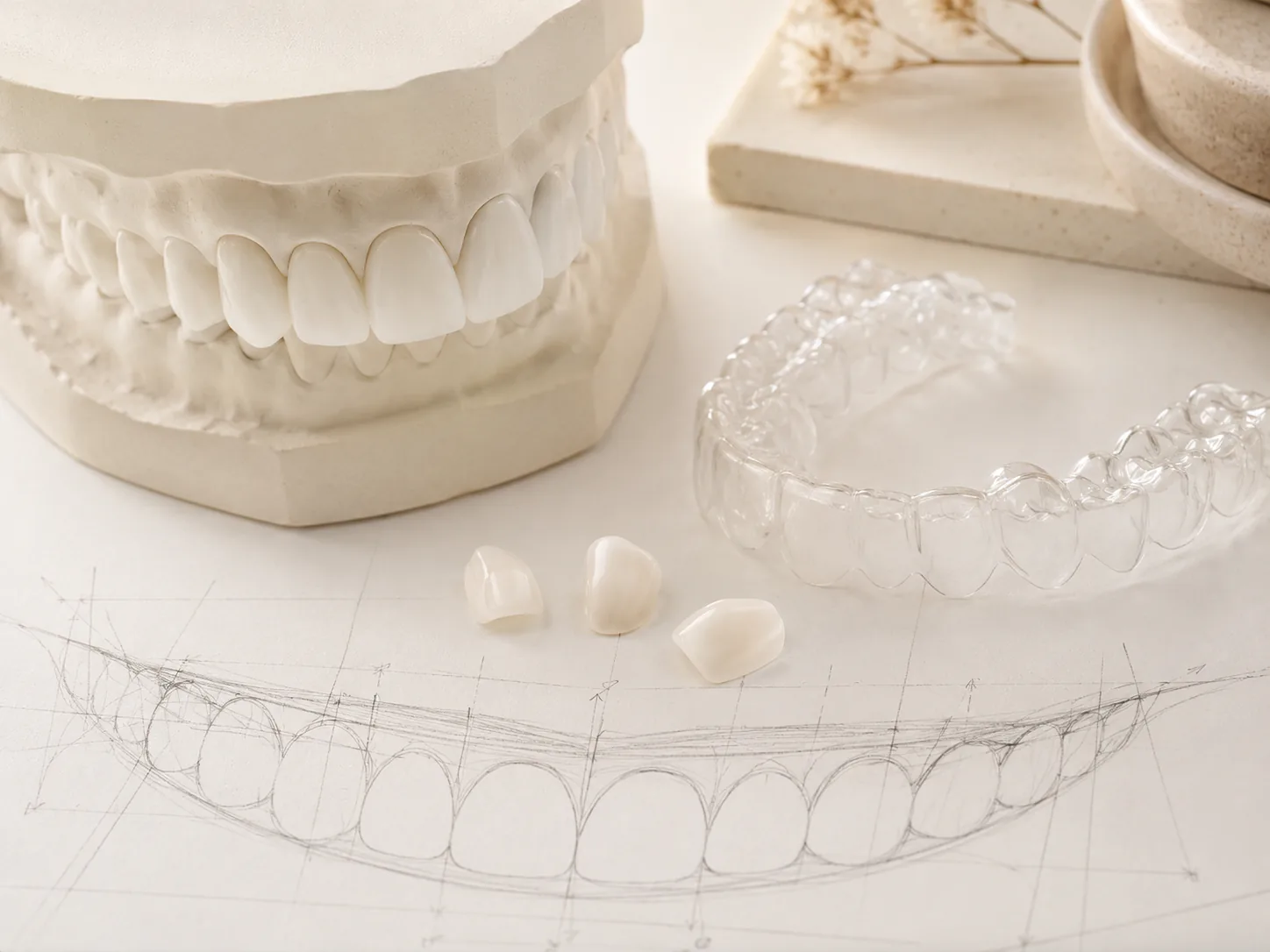
When patients want to improve their smile, veneers and orthodontics are often seen as two separate choices: one is faster, the other moves teeth; one is restorative, the other orthodontic.
In real aesthetic planning, they do not always replace each other. Some patients benefit from orthodontics before a small number of veneers; others need veneers only; some need both within one design logic.
The Problem You May Be Facing
Common concerns include mildly crowded teeth, protruding front teeth, gaps, uneven tooth size, an irregular arch form, or dissatisfaction with both color and shape.
Patients often ask, “Can I skip orthodontics and just do veneers?” The answer depends not only on time, but on tooth position. If the teeth are poorly positioned, using veneers to make them look aligned may require more tooth reduction or thicker restorations.
What Really Needs to Be Evaluated
First, the degree of malalignment matters. Minor spaces or shape issues may be managed restoratively. More obvious crowding, protrusion, rotation, or bite problems often require orthodontic evaluation.
Second, the source of the aesthetic problem matters. Some teeth are small and still need veneers after alignment. Others are normal in size but poorly positioned, making orthodontics more central.
Third, restorative space matters. Orthodontics may create space that allows thinner and more natural veneers.
Fourth, bite matters. Front tooth position, deep bite, and guidance affect veneer margins and long-term stability.
How D4 Usually Checks
D4 evaluates tooth position, facial proportion, smile line, bite, and restorative goals together. Photos, intraoral scans, X-rays, and sometimes CBCT or orthodontic analysis may be used.
For aesthetic restorations, Mockup helps preview proportion. For orthodontics, the goal is to determine whether tooth movement can make later restoration more conservative.
What Patients Should Know Before Treatment
Orthodontics is not only about straightening teeth. Before aesthetic restorations, it may help move teeth into a better position so veneers can be thinner and more natural.
Veneers are not only about whiteness. After orthodontics, they may still be useful if teeth are small, worn, uneven in color, or lacking proper proportion.
Combined treatment may take longer, but it can reduce compromise.
Common Misunderstandings
Do veneers mean I do not need orthodontics?
Not if tooth position is a major issue. Veneers do not move teeth; they only compensate with shape.
Does orthodontics mean I will not need veneers?
Not always. Orthodontics changes position, not tooth color, enamel quality, edge wear, or intrinsic size.
Is combined treatment excessive?
Not necessarily. In suitable cases, it can reduce tooth reduction and improve naturalness.
When to Consider a Consultation
If you are concerned about alignment, spacing, color, and smile proportion at the same time, start with a comprehensive evaluation rather than choosing veneers or orthodontics first.
Related Pathway
This article belongs to the aesthetic restoration pathway and also connects to adult orthodontic planning.
FAQ
Should orthodontics or veneers come first?
If tooth position affects veneer thickness, margins, or bite, orthodontics is often considered first.
Do small gaps always need orthodontics?
No. Some gaps are caused by tooth size and can be managed restoratively; others are related to arch or bite.
When can veneers be done after orthodontics?
After the gum, bite, and retention plan are stable. Timing varies.
Will veneers affect retainers?
Yes. Retainers usually need to be remade after veneers.