Dental laser applications · D4 Shanghai

Laser dentistry.More options for precise, conservative care.

At D4 in Shanghai, dental lasers are used for gum and soft-tissue contouring, porcelain veneer removal, periodontal treatment, second-stage implant surgery, and adjunct root-canal disinfection.

Clinician using an intraoral instrument during dental treatment

Why choose a laser for these treatments?

Remove old veneers while preserving the tooth

When the ceramic and bonding conditions are suitable, laser-assisted debonding can reduce the need to grind away the veneer and the risk of removing underlying tooth structure, making removal more efficient.

Explore veneer removal →

Gum shaping with local bleeding control

In suitable soft-tissue procedures, a laser can contour the gum while helping control local bleeding, giving the clinician a clearer view of the margin.

Explore crown lengthening →

Support for cleaning and disinfection

In selected periodontal and root-canal steps, lasers can help treat infected areas and reduce local bacteria.

Explore periodontal care →

Treatment applications

Laser applications in dental treatment

Veneer removal, gum contouring, and adjunct disinfection use lasers for different purposes and require different techniques.

Featured applications

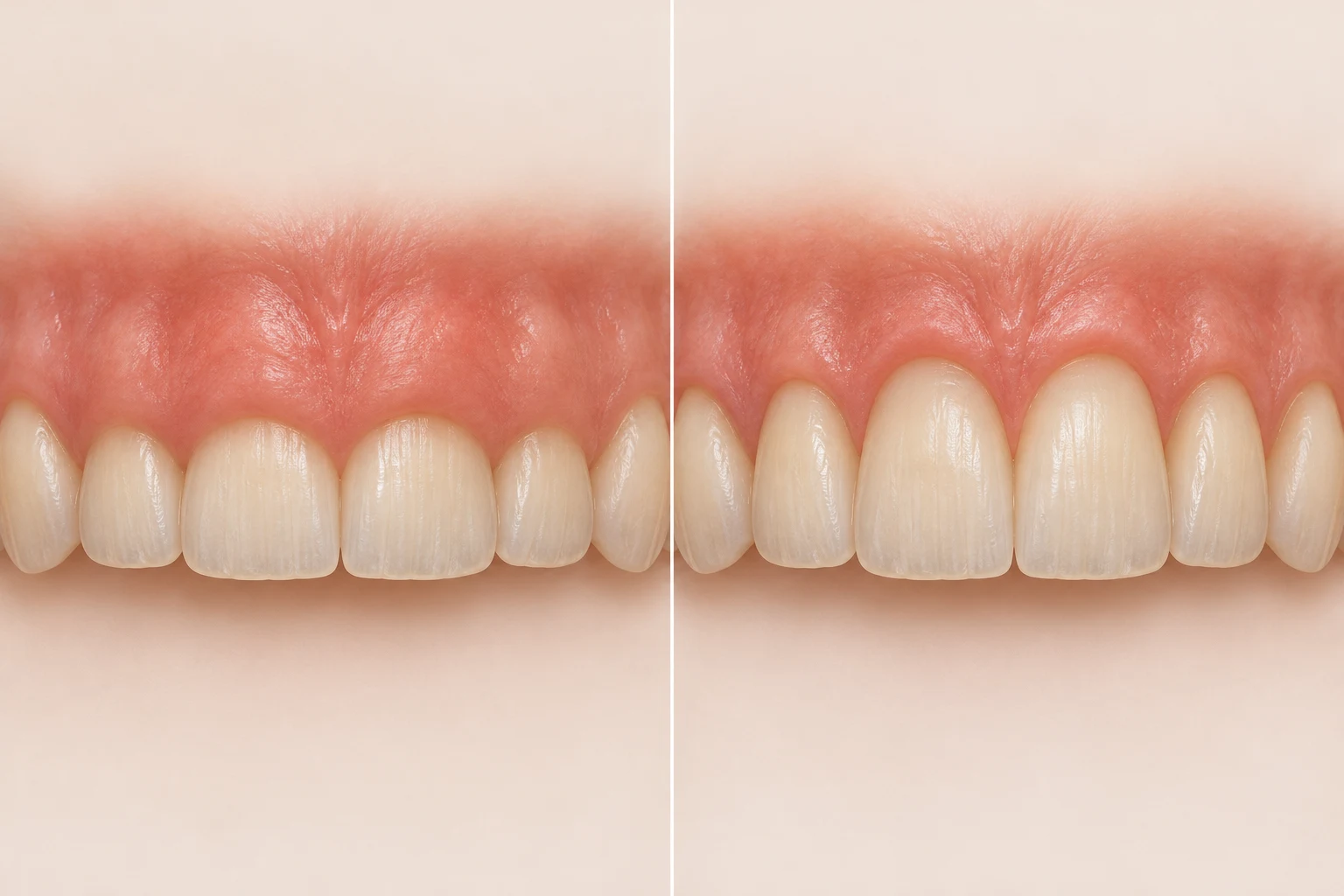
Before

More gum coverage, shorter-looking teeth

After

More of the natural crown exposed

Crown lengthening diagram showing the gum margin adjusted to reveal more of the existing crown
Adjusting the gum margin reveals the tooth crown that was covered by gum.

Gum line and smile proportions

Laser-Assisted Crown Lengthening and Gum Contouring

When teeth look short, gums show when you smile, or the gum line appears uneven, the clinician first checks whether gum coverage is a factor. When indicated, crown lengthening adjusts the gum margin to reveal tooth structure that was covered, bringing visible tooth length and the gum line into better proportion.

D4 includes tooth display, the gum line, and tooth proportions in DSD planning. Periodontal attachment and bone conditions guide the surgical plan so the gum line works with the planned veneers or crowns.

Shape the gum with less bleeding in the working area

A conventional scalpel primarily cuts tissue. In suitable soft-tissue procedures, a laser with a coagulating effect can contour the gum while helping control local bleeding. This gives the clinician a clearer view when working along the planned gum line.

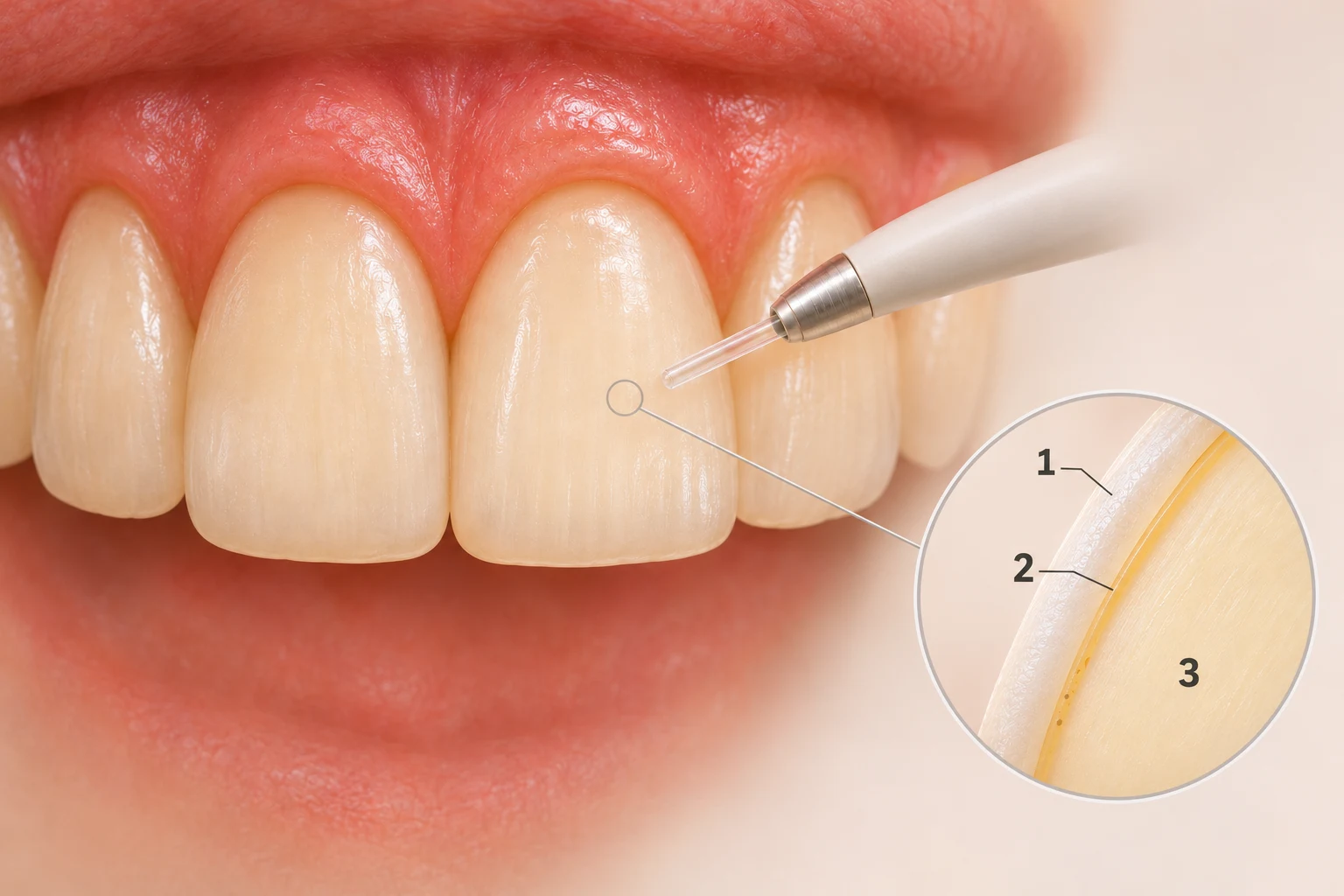
Dental laser aimed at a front tooth veneer, with an inset showing the bonding layer underneath
  1. Ceramic veneer
  2. Bonding layer
  3. Natural tooth
The laser can help loosen the bonding layer beneath the veneer, making the old veneer easier to remove.

Replacing old veneers

Laser-Assisted Porcelain Veneer Removal

How are old porcelain veneers removed when they need replacing? When the ceramic, thickness, and bonding conditions are suitable, a water-assisted erbium laser can pass through the ceramic and act on the bonding layer, helping weaken the bond and assisting the clinician in removing the old veneer.

Before replacing old veneers, D4 checks the ceramic, thickness, and bonding material to choose an approach that considers both tooth preservation and removal efficiency.

Less grinding, more focus on tooth preservation

Rotary removal usually involves grinding away the ceramic and carefully identifying the boundary near the tooth surface. In suitable cases, laser-assisted debonding can reduce repeated grinding and the risk of inadvertently removing underlying tooth structure, supporting efficient removal with a focus on tooth preservation.

Other laser applications

Laser Use in Periodontal Treatment and Surgery

Repeated gum bleeding and deepening periodontal pockets may be signs of periodontitis. Treatment focuses on cleaning the infected areas below the gum and maintaining the tissues that support the teeth.

At D4, pocket location, the degree of inflammation, and the surgical plan guide where and how a laser is used as an adjunct.

Treat inflamed tissue and support bacterial control

Mechanical instruments remove plaque and calculus and clean root surfaces. A laser can treat selected inflamed soft tissue and help control local bacteria. In suitable soft-tissue surgery, coagulation can also help control bleeding and give the clinician a clearer view of the treatment area.

Laser Use During Second-Stage Implant Surgery

Some implants heal beneath the gum. Before the restorative phase, a second-stage procedure exposes the implant so a healing abutment can be connected.

In suitable cases, D4 can use a laser to open and contour the soft tissue over an implant. The extent of treatment depends on implant position, gum thickness, and the gum tissue that needs to be preserved.

Control local bleeding for healing-abutment placement

Compared with scalpel incision, an appropriate laser can open the local soft tissue while helping control bleeding, making the implant connection easier to see. Where only limited exposure is needed and tissue conditions are suitable, it may also reduce the need for flap elevation and suturing, simplifying the second-stage procedure.

Laser-Assisted Disinfection in Root Canal Treatment

Root canals contain small branches and irregular spaces. D4 selects laser-assisted disinfection according to canal anatomy and infection to help reduce bacteria within the canal.

Support disinfection beyond direct instrument contact

Root-canal instruments mainly clean the canal walls they can contact. With an appropriate wavelength and settings, laser energy can act on bacteria within dentinal tubules, supporting disinfection in areas beyond direct instrument contact. The clinician plans this adjunct step according to canal anatomy and infection.

The basics

What Is a Dental Laser and What Does It Do?

Dental lasers use light at a specific wavelength to treat oral tissues. Energy absorbed by water, pigments, and other tissue components can be used to cut or shape tissue or to support cleaning and disinfection.

D4 uses water-assisted erbium lasers and diode lasers according to the treatment. Different wavelengths act differently on gums, tooth structure, and restorative materials, so gum contouring, veneer removal, and adjunct disinfection each require an appropriate laser type and settings.

Clinical team

D4’s Laser Dentistry Team

Dr. Elaine Niu is a Fellow of the World Clinical Laser & Imaging Institute (WCLI) and received WCLI Fellowship Certification in 2013. Dr. Herman Hsu is a WCLI Associate Fellow.

Discuss your case

Discuss your treatment needs with D4

Contact D4 by WeChat or phone to discuss whether a dental laser could be useful in your treatment. Any existing examination records can be reviewed at your in-person consultation.

Contact D4 →